Difference Between Dwarflabs Dwarf III and Nikon Z 24-70mm f/2.8 S II Explained
The landscape of modern photography is currently undergoing a massive divergence. On one side, we have the traditional excellence of high-end optical engineering, represented by the legendary "trinity" lenses used by professionals. On the other, we see the rise of highly specialized, smart robotic imaging systems that leverage artificial intelligence to automate complex tasks like astrophotography and wildlife tracking. Comparing the Dwarflabs Dwarf III to the Nikon Z 24-70mm f/2.8 S II might seem like comparing a Swiss Army knife to a scalpel, but for many enthusiasts, the decision often comes down to how they want to experience the act of capturing an image.
The Nikon Z 24-70mm f/2.8 S II (the anticipated successor to the current S-line standard) represents the pinnacle of versatile, manual-interaction glass. It is a tool designed for the decisive moment, requiring a photographer's eye and a camera body to function. Conversely, the Dwarflabs Dwarf III is an all-in-one smart telescope and camera system. It is a self-contained robot that finds stars, tracks birds, and processes images internally. This article explores the nuanced differences between these two distinct paths to high-quality imagery, examining their optics, technology, and the specific types of creators they serve.
Understanding the Core Philosophies
To understand the difference between these two products, one must first understand their fundamental purpose. The Nikon Z 24-70mm f/2.8 S II is a "workhorse" lens. It is built to be the only lens a professional photographer needs for 80% of their work, covering everything from wide-angle landscapes at 24mm to flattering portraits at 70mm. It relies on the Nikon Z-mount ecosystem, meaning its performance is tied to the sensor, autofocus system, and ergonomics of a camera like the Nikon Z8 or Z9.
The Dwarf III, developed by Dwarflabs, is a "smart" imaging device. It does not mount to a camera; it is the camera, the lens, and the tripod head all in one. It uses periscopic optics and dual-camera systems to provide both a wide-field view and a telephoto view. While the Nikon lens is about the tactile experience of photography—turning a zoom ring, looking through an EVF, and clicking a mechanical shutter—the Dwarf III is about the result. It is controlled via a smartphone app, allowing the user to sit in a warm car while the device tracks the Nebula or a distant eagle in the cold outside.
The Nikon Z 24-70mm f/2.8 S II: Optical Perfection
The Nikon Z 24-70mm f/2.8 S II is expected to build upon the already industry-leading performance of its predecessor. In the world of optics, "S-Line" denotes Nikon’s highest level of quality. This lens is designed to resolve the 45-megapixel and higher sensors found in professional Nikon camera bodies. Its primary appeal lies in its constant f/2.8 aperture, which provides consistent exposure and depth-of-field control throughout the zoom range.
Optical Engineering and Image Quality
The Nikon lens utilizes a complex arrangement of Extra-low Dispersion (ED) and Aspherical elements. These are designed to eliminate chromatic aberration and coma—the very things that a telescope like the Dwarf III also strives to minimize, though via different methods. The "S II" iteration focuses on reducing weight while improving "ghosting" and "flare" resistance through advanced coatings like Arneo and Nano Crystal Coat. For the professional photographer, this means images that are sharp from corner to corner, even when shooting directly into the sun during a wedding or a sunset landscape session.
Versatility in Professional Environments
The 24-70mm focal range is the industry standard for versatility. At 24mm, it captures the scale of an architectural masterpiece. At 35mm and 50mm, it provides a naturalistic view for street photography and documentary work. At 70mm, the f/2.8 aperture creates a beautiful bokeh (background blur) that isolates subjects for portraiture. This lens is a favorite for journalists, wedding photographers, and event shooters who cannot afford to swap lenses as the action unfolds.
The Dwarflabs Dwarf III: The Smart Revolution
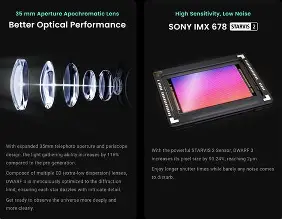
The Dwarf III is the third generation of a product that essentially created a new category: the sub-compact smart telescope. Unlike the Nikon lens, which is purely glass and metal, the Dwarf III is a computer. It features an integrated Sony IMX678 sensor, which is a modern Starvis 2 back-illuminated sensor capable of incredible low-light sensitivity. This is paired with a dual-lens system: a wide-angle lens for general orientation and a telephoto lens for deep-space and long-range observation.
Shop the latest Cameras & Photography picks on Amazon.
View Offers →Artificial Intelligence and Automation
The "killer feature" of the Dwarf III is its AI-assisted tracking. In astrophotography, the biggest hurdle is the Earth's rotation, which causes stars to "streak" during long exposures. The Dwarf III handles the "GoTo" and "Tracking" functions automatically. A user selects an object—like the Orion Nebula or the Andromeda Galaxy—on their phone screen, and the Dwarf III uses plate-solving technology to identify the star field and center the object. It then compensates for Earth's rotation by moving its internal motors.
Dual-Lens Capability
One of the most unique aspects of the Dwarf III compared to a traditional zoom lens is how it handles different focal lengths. Instead of moving glass elements back and forth like the Nikon 24-70mm, the Dwarf III switches between two dedicated optics. This allows it to offer a wide view to help you find your subject (like a bird in a tree) and then instantly switch to the telephoto view to capture a 4K video or a high-resolution photo of that subject. For wildlife enthusiasts, this removes the "hunting" phase often associated with trying to find a small bird through a powerful telephoto lens.
Technical Comparison Table
| Feature | Nikon Z 24-70mm f/2.8 S II | Dwarflabs Dwarf III |
|---|---|---|
| Device Type | Interchangeable Camera Lens | All-in-One Smart Robotic Camera/Telescope |
| Effective Focal Length | 24mm to 70mm | Wide-angle and ~700mm equivalent (Tele) |
| Aperture | Constant f/2.8 | Fixed (f/4.2 on telephoto) |
| Sensor | None (Uses Camera Sensor) | Integrated Sony IMX678 (Starvis 2) |
| Primary Use Case | Weddings, Events, Portraits, Landscape | Astrophotography, Wildlife, Time-lapse |
| Weight | Approx. 800g (Lens only) | Approx. 1.3kg (Full System) |
| Control Method | Manual/On-Camera Buttons | Smartphone App (iOS/Android) |
| Portability | Requires Camera Bag | Fits in a Large Coat Pocket/Small Case |
Real-World Use Cases
The Landscape and Event Professional (Nikon Case)
Imagine a wedding photographer working in a dimly lit cathedral. They need to move from the back of the church to the altar quickly. The Nikon Z 24-70mm f/2.8 S II is indispensable here. The f/2.8 aperture allows enough light into the camera to keep the ISO low and the shutter speed high enough to freeze a walking bride. The weather-sealing on the Nikon lens ensures that if the couple wants a few shots in a light drizzle outside, the gear will survive. The tactile feedback of the zoom ring allows the photographer to frame the shot instantly, relying on their intuition and the camera's high-speed Eye-Detection AF.
The Backyard Astronomer and Hiker (Dwarf III Case)
Contrast that with a hiker who reaches a ridge at sunset. They want to capture the Milky Way appearing over the peaks, but they don't want to carry a 10lb tripod and an equatorial mount. They pull the Dwarf III out of their backpack. It’s the size of a thick paperback book. They set it on a flat rock. Using their phone, they command the device to "Auto-Calibrate." The Dwarf III scans the sky, figures out where it is in the world, and then perfectly tracks the Galactic Center. While the hiker eats dinner, the Dwarf III takes 100 deep-space exposures and stacks them internally to produce a noise-free image of a nebula that is invisible to the naked eye. This is a level of ease that no traditional lens can provide without thousands of dollars in supporting equipment.
Pros and Cons Analysis
Nikon Z 24-70mm f/2.8 S II
- Pros: Unmatched optical clarity and sharpness across the frame; constant f/2.8 aperture is vital for low-light depth control; legendary build quality and weather sealing; extremely fast and silent autofocus motors; holds resale value exceptionally well.
- Cons: Requires an expensive Nikon Z-mount camera body to function; heavy when paired with a pro body; focal length is limited for wildlife or distant astronomy; very high entry price.
Dwarflabs Dwarf III
- Pros: Fully integrated system including sensor, lens, and motorized mount; AI tracking makes complex astrophotography accessible to beginners; dual-lens system is perfect for "find and zoom" wildlife spotting; compact and highly portable; very affordable compared to a telescope + camera setup.
- Cons: Small sensor size limits resolution and dynamic range compared to Full Frame cameras; dependent on a smartphone app for all controls; not suitable for fast-action sports or weddings; fixed batteries mean limited field life without a power bank.
The Buying Guide: Which One Should You Choose?
Choosing between these two depends entirely on your existing gear and your photographic goals. The decision is rarely about which is "better," but rather which tool fits the slot in your creative arsenal.
Buy the Nikon Z 24-70mm f/2.8 S II if:
You are a professional or a serious hobbyist who already owns—or plans to own—a Nikon Z6, Z7, Z8, or Z9. If your work involves people, events, or street photography where you need to react in real-time, this lens is the benchmark. It is for the person who wants to be "in" the process, making every decision about exposure, focus, and framing. It is a long-term investment in glass that will likely outlast several camera bodies.
Buy the Dwarflabs Dwarf III if:
You are fascinated by the night sky or distant wildlife but find the technical hurdles of traditional telescopes and long-lens photography daunting. If you want a device that can live in your day-pack and provide images of the Moon, Saturn's rings, or nesting birds without requiring a PhD in optics, the Dwarf III is revolutionary. It is for the "smart tech" enthusiast who values convenience, portability, and the power of computational photography over manual control.
Find top-rated Cameras & Photography products at great prices.
Shop Amazon →Technical Challenges: Resolution vs. Aperture
A major point of contention between these two styles of imaging is the "Full Frame Advantage." The Nikon lens projects onto a sensor that is roughly 36mm x 24mm. This large surface area captures a massive amount of light and provides a "look" characterized by smooth transitions and high dynamic range. The Dwarf III uses a much smaller 1/1.8-inch type sensor. In daylight, the difference is noticeable; the Nikon will have more "soul" and detail in the highlights and shadows. However, in the specific niche of deep-space photography, the Dwarf III's ability to track and stack images for hours actually allows it to "beat" a handheld Nikon camera in terms of what it can actually see in the dark. It is a classic case of specialized software (Dwarf III) vs. raw hardware power (Nikon).

Maintenance and Longevity
The Nikon S II lens is a mechanical and optical masterpiece. With proper care—avoiding sand and cleaning the elements with the right solution—it can function perfectly for twenty years. It is "future-proof" in the sense that as sensors get better, the glass is already good enough to handle them. The Dwarf III, being a digital device with an integrated battery, sensor, and firmware, has a shorter expected lifespan. Like a smartphone, the battery will eventually degrade, and the software might eventually become obsolete. This makes the Dwarf III a "buy for now" tool, whereas the Nikon is a "buy for life" instrument.
Conclusion
The Nikon Z 24-70mm f/2.8 S II and the Dwarflabs Dwarf III represent two different eras of photography living side-by-side. The Nikon is the refinement of a century of optical science, offering the highest possible quality for the photographer who wants total control and ultimate reliability. It remains the vital centerpiece of any professional's kit, capable of handling almost any standard photographic task with grace and precision.
The Dwarf III is the herald of a new age, where the camera is no longer just a passive observer but an active participant. By automating the most difficult parts of long-range and night photography, it opens up the wonders of the cosmos and the natural world to anyone with a smartphone. It isn't a replacement for a professional camera and lens, but rather a specialized companion that does things a 24-70mm lens simply cannot do.
Ultimately, the choice comes down to your passion. If you love the craft of the shot, the weight of the camera in your hand, and the versatility of a standard zoom, the Nikon is your choice. If you love the discovery of the hidden—the craters on the moon or the colors of a distant nebula—and you want the most frictionless path to seeing them, the Dwarf III is the future of your hobby.